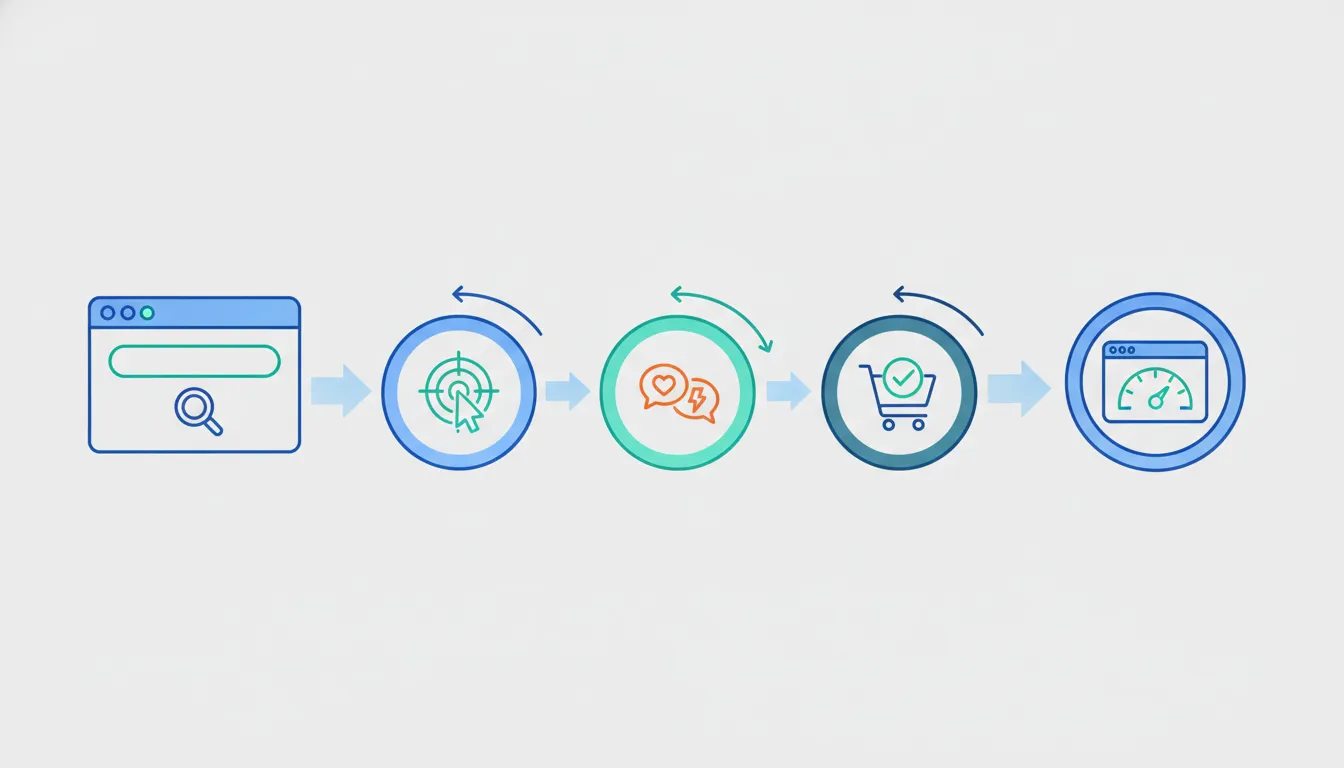
Website Optimization Beyond Traditional SEO: How to Improve User Intent, Engagement, and Conversions
If your pages are ranking for keywords but still not generating meaningful results, the problem may not be visibility alone. In many cases, the bigger issue is relevance. Modern website optimization is no longer just about matching search terms. It is about understanding what people actually want when they land on your site and delivering a better experience from the first click.
That shift matters because user intent sits at the center of strong engagement and better conversion performance. When a page closely matches what someone is trying to accomplish, they are more likely to stay longer, interact, and take action. When it misses the mark, they leave.
This guide explains how to optimize a website beyond conventional SEO tactics, with a practical focus on search query patterns, intent-driven content, and experience improvements that help turn traffic into results — the same principles behind our conversion rate optimization and SEO work.
In This Article
Want us to build this for you?
Book a Free Discovery Call- What Website Optimization Beyond Traditional SEO Really Means
- Why User Intent Matters More Than Keyword Matching Alone
- Signs Conventional SEO Is No Longer Enough
- How To Find User Intent Using Search Query Data
- How To Create Hyper-Relevant Content That Matches Intent
- How Intent Optimization Improves Engagement and Conversions
- A Simple Framework for Intent-First Website Optimization
- Common Mistakes To Avoid
- FAQs About Website Optimization Beyond SEO
- Final Thoughts
What Website Optimization Beyond Traditional SEO Really Means
Want us to build this for you?
Book a Free Discovery CallTraditional SEO often focused heavily on placing the right keywords in titles, headings, URLs, and body copy. Those elements still matter, but they are no longer enough on their own.
Website optimization beyond traditional SEO means looking at your site from the user's perspective, not just the search engine's perspective. The goal is to align your page with the reason behind the search.
In practical terms, that means asking questions like these:
- What is the visitor trying to learn?
- What problem are they trying to solve?
- What action are they hoping to take next?
- Does this page satisfy that need quickly and clearly?
This approach combines SEO, user experience, and conversion thinking into one strategy. Instead of chasing rankings alone, you optimize for outcomes that matter after the click.
Why User Intent Matters More Than Keyword Matching Alone
Want us to build this for you?
Book a Free Discovery CallA keyword tells you what someone typed. User intent helps you understand why they typed it.
That distinction changes everything.
For example, a person searching for a broad phrase may be looking for a definition, a comparison, a step-by-step guide, or a service provider. If your page ranks for the phrase but answers the wrong need, it may still underperform.
When you align a page with intent, several things tend to improve:
- Engagement, because the content feels immediately useful
- Time on page, because visitors find what they expected
- Conversion rates, because the next step feels natural
- Bounce resistance, because the page solves the problem instead of creating friction
Google has increasingly rewarded pages that satisfy searchers, not just pages that repeat query terms. Helpful content, clarity, and relevance are all part of that shift. Google's own documentation on creating helpful, reliable, people-first content supports this direction.
Signs Conventional SEO Is No Longer Enough
Want us to build this for you?
Book a Free Discovery CallA website can appear optimized on the surface and still fail to produce business results. Here are a few common signs that your current strategy may be too focused on conventional SEO alone:
- Your pages rank, but visitors do not convert
- You get impressions, but click quality is weak
- Traffic lands on the page and leaves quickly
- Your content targets keywords, but does not answer specific needs
- Visitors seem confused about what to do next
- Pages are technically optimized but feel generic or disconnected from search intent
If any of these sound familiar, the issue may not be that you need more keywords. It may be that you need better alignment between the search, the page, and the user's goal.
How To Find User Intent Using Search Query Data
Want us to build this for you?
Book a Free Discovery CallOne of the most useful starting points is search query data. Instead of guessing what people want, review the terms they are actually using to find your site and look for patterns.
What to look for in query patterns
Search query analysis helps you identify clusters of intent. Even when several phrases are closely related, the wording often reveals different expectations.
Pay attention to patterns like these:
- Informational intent: searches that suggest someone wants to understand a topic
- Problem-solving intent: searches that show urgency or a need for a fix
- Action-oriented intent: searches that imply readiness to contact, buy, sign up, or request help
- Specificity: searches with more detail usually signal a clearer expectation
For example, a broad query and a more specific query should not always lead to the same style of page. One may need education. Another may need a direct solution.
Where to get query data
Useful sources include:
- Google Search Console
- Your site search data, if your website has internal search
- Paid search query reports, if you run ads
- Customer support questions and contact form submissions
Search Console is especially valuable because it shows the exact terms generating impressions and clicks. This makes it easier to compare what you think a page is about versus how searchers actually interpret it.
How to interpret the data
Look for recurring themes rather than isolated phrases. Ask:
- Which words appear repeatedly?
- Are people asking how, why, what, or where?
- Do certain phrases suggest confusion or urgency?
- Is the traffic landing on the best page for that query?
The goal is to identify intent clusters. Once you see those clusters, you can build or refine pages so they answer those needs more directly.
How To Create Hyper-Relevant Content That Matches Intent
Want us to build this for you?
Book a Free Discovery CallOnce you understand query patterns, the next step is to build content that directly addresses them. This is where many websites fall short. They create pages around topics, but not around specific needs.
Hyper-relevant content is content that feels like the right answer for a very specific search context.
What makes content feel hyper-relevant?
- It answers the core question quickly
- It uses language that matches the user's problem
- It avoids vague filler and gets to the point
- It offers a logical next step
- It is structured so the visitor can scan and act
For example, if a search pattern shows that people are trying to solve a specific website issue, the page should not open with a broad essay about digital marketing. It should clearly explain the issue, why it matters, and how to address it.
Ways to improve relevance on a page
- Rewrite introductions so they immediately confirm the page matches the searcher's need
- Tighten headings so each section answers a likely sub-question
- Add clearer next actions such as contacting, booking, comparing, or reading a related page
- Remove generic language that could belong on any website
- Use examples that reflect real search intent scenarios
This type of optimization often improves both usability and SEO at the same time because it reduces mismatch between the search query and the landing page experience.
How Intent Optimization Improves Engagement and Conversions
Want us to build this for you?
Book a Free Discovery CallIt is easy to think of SEO and conversions as separate tasks, but they are closely connected when intent is involved.
If a visitor lands on a page that immediately feels relevant, several positive things can happen:
- They keep reading instead of returning to search results
- They trust the page more quickly
- They are more open to clicking deeper into the site
- They are more likely to complete a form, request a quote, or take another valuable action
In other words, intent alignment improves the quality of the traffic experience. That is why it can have a direct effect on conversion performance.
A page that only targets rankings may attract visits. A page that targets intent is more likely to generate results from those visits.
A Simple Framework for Intent-First Website Optimization
Want us to build this for you?
Book a Free Discovery CallIf you want a repeatable way to apply this approach, use the framework below.
Step 1: Review your existing search queries
Start with pages that already receive impressions or clicks. Look for common wording patterns and signs of repeated intent.
Step 2: Group similar queries by need
Do not treat every keyword as a separate project. Group them into categories based on what the searcher appears to want.
For example:
- Learning intent
- Comparison intent
- Fix-it intent
- Action or conversion intent
Step 3: Match each intent group to the right page type
Different intent types usually need different content formats.
- Learning intent often fits guides, explainers, and FAQs
- Problem-solving intent often fits troubleshooting pages or direct how-to content
- Action intent often fits service pages, contact pages, or landing pages with stronger calls to action
Step 4: Rewrite for clarity and specificity
Adjust the page so it directly addresses the user's need in the headline, opening paragraph, and section headings.
Step 5: Improve the next step
If the visitor is ready to act, make that easy. If they need more information first, guide them to the next most relevant resource.
Step 6: Monitor engagement and conversion behavior
After updating the page, review what changes. Look at engagement, click paths, and conversion performance. If the page is more aligned with intent, user behavior should improve.
Quick Checklist for Unconventional Website Optimization
Want us to build this for you?
Book a Free Discovery Call- Review search query data regularly
- Identify repeated patterns in user wording
- Optimize pages around needs, not just phrases
- Make page introductions more direct
- Use headings to answer real sub-questions
- Reduce generic copy that does not help the visitor
- Create clearer paths to the next action
- Measure whether users stay, engage, and convert
Common Mistakes To Avoid
Want us to build this for you?
Book a Free Discovery CallMany websites attempt to move beyond traditional SEO but fall into avoidable traps. Here are some of the most common ones.
Focusing on keywords without context
A keyword is useful data, but it is incomplete by itself. If you optimize for the phrase and ignore the need behind it, the page can still miss the mark.
Creating broad content for specific searches
Specific searches usually require focused answers. A broad page may feel too general and force the visitor to work too hard to find what matters.
Ignoring post-click experience
Ranking is only the beginning. If the page is hard to scan, unclear, or disconnected from the search, the opportunity is wasted.
Assuming traffic equals success
Traffic is useful, but not all traffic is valuable. If engagement is weak and conversions are low, intent mismatch may be the real issue.
Writing for search engines instead of people
The strongest pages tend to do both. They are discoverable because they are clear, and they perform because they are genuinely useful.
Who Should Use This Approach?
Want us to build this for you?
Book a Free Discovery CallThis strategy is especially useful for:
- Businesses getting traffic but not enough leads
- Sites with pages that rank but do not convert
- Service providers trying to improve landing page performance
- Content teams looking to make pages more useful and more targeted
- Website owners who feel conventional on-page SEO has plateaued
If your site already has basic SEO in place, intent-based optimization is often the next logical step, and a strong technical foundation from our web design service makes it easier to execute.
Related Resources
Want us to build this for you?
Book a Free Discovery Call- Google SEO Starter Guide
- Google guidance on helpful content
- Google Search Console performance reporting
FAQs About Website Optimization Beyond SEO
Want us to build this for you?
Book a Free Discovery CallWhat is the difference between traditional SEO and user intent optimization?
Traditional SEO often emphasizes keyword placement and technical signals. User intent optimization goes further by aligning the page with what the searcher is actually trying to accomplish. It focuses on relevance, usefulness, engagement, and next-step clarity.
Can a page rank well and still perform poorly?
Yes. A page can rank for a query but still have weak engagement or low conversion rates if it does not meet the visitor's expectations. Rankings alone do not guarantee results.
How do I know if my content matches user intent?
Start by reviewing search query data and visitor behavior. If people click through, stay on the page, interact, and move toward conversion, that is a good sign. If they leave quickly or do not take the next step, the page may not match intent closely enough.
What is hyper-relevant content?
Hyper-relevant content is content built around a very specific user need or search pattern. It answers the main question quickly, uses clear language, and gives the visitor a logical next action.
Why does user intent matter for conversions?
When a page closely matches what someone wants, trust builds faster and friction drops. That makes it easier for visitors to continue exploring, submit a form, request help, or complete another meaningful action.
What is the best first step to optimize beyond conventional SEO?
Review your search query data and look for patterns in what people are trying to find. That insight helps you rewrite pages to better match intent, which is often more effective than adding more keywords.
Final Thoughts
Want us to build this for you?
Book a Free Discovery CallThe most effective website optimization strategies now go beyond conventional SEO checklists. Keywords still matter, but they are only one part of the picture. Real performance comes from understanding what people want, creating content that directly answers that need, and making the path forward clear.
If your current SEO efforts are not moving the needle, it may be time to stop optimizing only for search terms and start optimizing for intent. That is often where stronger engagement, better user experience, and higher conversions begin. For a local angle on this same principle, see our guide on local semantic SEO and matching search intent, and if traffic still isn't converting once it arrives, our breakdown of why your website might not be generating leads covers the rest of the funnel.
Ready to turn intent-aligned traffic into real leads? Book a discovery call with Certtech Web Solutions to discuss a customized strategy for your business.