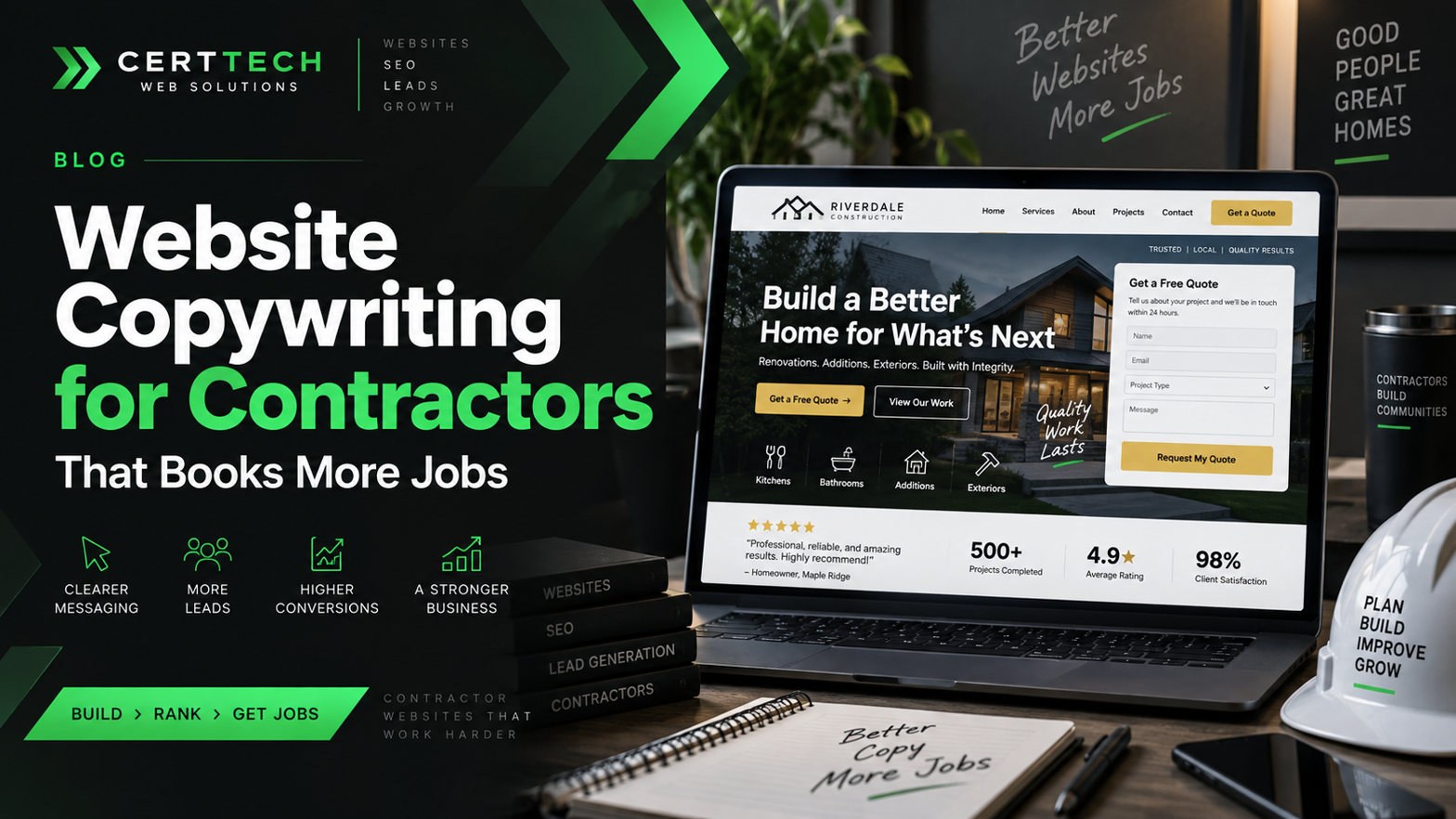
Website Copywriting for Contractors That Books More Jobs
This guide is for contractors, tradespeople, and home service businesses across Canada who want their website to generate consistent quote requests — not just traffic that disappears.
If you're a contractor in Barrie, Ontario, or anywhere else in Canada, you've probably put real money into a website. Maybe you had someone design it, or you built it yourself. Either way, the phone isn't ringing the way it should.
The problem usually isn't your design. It's your words.
Website copywriting for contractors is one of the most overlooked parts of building a site that actually works. This guide breaks down exactly why most contractor websites fail to convert, what good copy looks like on every key page, and how to write in a way that both Google and real customers respond to.
Why Most Contractor Websites Fail Before Anyone Reads a Word
Want us to build this for you?
Book a Free Discovery CallMost contractor websites lose visitors within the first few seconds. Not because the site looks bad, but because the messaging is weak or unclear.
When someone lands on your homepage and can't immediately answer three basic questions — what do you do, who do you help, and why should I trust you? — they leave. And they don't come back.
This is the core problem with most trade business websites. The copy is either too vague, too focused on the company itself, or buried under visual noise. Visitors don't take the time to figure out if you're the right fit. They simply move on to the next result.
This is one of the reasons professional web design for contractors and local businesses needs to focus on more than appearance. The messaging, structure, and conversion path all have to work together.
According to Nielsen Norman Group, users read only about 20% of the text on any given web page. That makes your above-the-fold headline one of the highest-leverage pieces of copy on your entire contractor website. If that section doesn't land, the rest of the page may never get a chance.
The Difference Between a Brochure Website and a Lead-Generation Website
A brochure website lists your services. It tells people what you do, maybe shows some photos, and hopes they'll figure out the next step on their own.
A lead-generation website does something completely different.
It speaks directly to a customer's problem, answers their hesitations, builds trust, and guides them toward one clear action — booking a quote or picking up the phone.
Effective copywriting is what separates these two types of sites. It's not about having more words on the page. It's about having the right words, placed in the right order, built around what your customer actually needs to hear before they trust you with their home or business.
What Is Conversion-Focused Website Copywriting?
Want us to build this for you?
Book a Free Discovery CallConversion-focused copywriting isn't about clever writing or flowery language. It's about precision.
Every headline, subheading, paragraph, and call-to-action on your site should help reduce friction and move the reader one step closer to booking a quote or picking up the phone. Nothing should be there simply to fill space.
For contractors, this means writing copy that answers the real questions people have before they hire someone:
- Can I trust this company?
- Are they local?
- Have they done this kind of job before?
- Do they have good reviews?
- What will this cost?
- What happens after I contact them?
- How quickly will they respond?
When your copy answers those questions proactively, the path from visitor to lead becomes much shorter.
This is the foundation of effective conversion rate optimization — removing unnecessary barriers between a potential customer's interest and the action you want them to take.
The Core Elements of High-Converting Contractor Copy
There are a handful of things that consistently show up on contractor websites that convert well. Each element works together to build confidence and move the reader toward action.
A Strong Value Proposition Above the Fold
Before a visitor scrolls even once, they need to understand what you do, where you do it, and why you're the right choice.
Pain-point-driven headlines do the heavy lifting here.
Instead of:
"We Offer Roofing Services"
Try something closer to:
"Roof Leaks Repaired Fast in Barrie — No Surprises, No Runaround."
The second headline speaks directly to what the customer actually worries about.
Visible Trust Signals
Trust signals shouldn't be hidden in the footer.
Your years in business, licenses, certifications, insurance, guarantees, reviews, local reputation, and completed projects should be mentioned naturally throughout your website.
These elements give visitors both the emotional reassurance and logical proof they need before reaching out.
Clear Calls-to-Action
Don't wait until the end of the page to tell visitors what to do.
Calls-to-action should appear naturally throughout the page, including near the top, after important service information, after trust-building sections, and at the bottom of the page.
Examples include:
- Get Your Free Quote
- Request an Estimate
- Call Now
- Book a Consultation
- See If We Service Your Area
The next step should never be difficult to find.
How Tone of Voice Affects Contractor Website Performance
The way you write says almost as much as what you write.
Contractors who write the way their customers actually talk — plainly, confidently, and without unnecessary jargon — are much easier to trust than companies using stiff corporate language.
Your website copy should sound like a trusted local expert having a real conversation, not a press release from a company trying too hard to sound professional.
When someone in Barrie searches for a contractor, they're not looking for polished corporate jargon. They're looking for someone who clearly knows what they're doing and makes the process feel straightforward.
Copy that sounds human and grounded builds that trust much faster.
Writing Copy for Each Key Page on a Contractor Website
Want us to build this for you?
Book a Free Discovery CallDifferent pages on your website serve different roles in the buyer's journey.
A visitor landing on your homepage for the first time needs something very different from someone who has already read your homepage and is now researching a specific service.
Understanding what each page needs to accomplish is the starting point for writing copy that actually works.
Homepage Copy: Your Digital Storefront
Your homepage has one primary job: convince the right visitor that they're in the right place.
It needs to do this quickly, and it needs to do it without making the visitor work too hard.
Lead with a location-aware headline that immediately signals where you work and what you do. Follow that with a concise summary of your primary services without overwhelming the visitor.
Then give them a clear next step.
Instead of generic CTAs such as:
"Learn More"
Use something more specific:
"Get Your Free Quote Today"
or:
"Call Now for an Estimate."
The homepage isn't the place for your entire company history. It's the place for clarity and confidence.
Give visitors exactly what they need to determine whether you're the right contractor, then make it effortless to take the next step.
This combination of messaging, layout, trust signals, and calls-to-action is a major part of conversion-focused web design.
Service Pages: Speak to the Job, Not Just the Trade
Service pages that rank well and actually convert go beyond listing what you offer.
A page that simply says:
"We offer deck installation, deck repairs, and deck staining."
doesn't give Google or your customers very much information.
Compare that with a page that explains why homeowners in Barrie replace aging decks before summer, what the installation process looks like, how long a project generally takes, common material options, maintenance considerations, and what factors affect pricing.
That page is doing real work.
Strong service page copy addresses the specific problem the customer wants solved. It also includes relevant local information that helps Google understand where the business operates.
Most importantly, the page ends with a clear and frictionless path to contact.
No hunting for a phone number.
No buried contact form.
No wondering what happens next.
Your website's design and page structure should work together with the copy so that the visitor is naturally guided toward contacting you.
About Page Copy: Build Trust Before the First Call
Most contractors treat their About page as an afterthought.
It often ends up being a few generic sentences about being family-owned, providing quality workmanship, and putting customers first.
That's a missed opportunity.
People who visit your About page are often already considering hiring you. They're checking whether your company feels legitimate, established, trustworthy, and local.
Use the page to tell your actual story.
Explain why the company was started. Highlight credentials honestly. Mention years of experience. Share meaningful achievements and customer results.
If you've completed charitable work, supported local organizations, worked with recognizable businesses, or been part of the community for years, mention it.
People hire people they trust. Your About page should help establish that trust before the first phone call ever happens.
Local SEO and Copywriting: A Powerful Combination
Want us to build this for you?
Book a Free Discovery CallGreat copy doesn't just convert the people who land on your website. It can also help more of the right people find you in the first place.
When your messaging aligns with local search intent, your website can do two jobs at once:
- Attract relevant local traffic.
- Convert that traffic into leads.
This is where professional copywriting and local SEO services become especially powerful together.
For Ontario trade businesses and Canadian home service companies in general, local relevance in your copy helps Google understand the geographic markets your company serves.
The challenge is doing it naturally.
Your content should serve the reader first — not sound like a list of city names written for a search engine.
How to Naturally Weave Location Keywords Into Your Copy
Forcing city names into every paragraph is an obvious red flag for both search engines and real visitors.
It sounds unnatural and quickly erodes trust.
A better approach is to reference your service area within useful context.
For example:
"We recently completed a full basement waterproofing project for a homeowner in South End Barrie."
You can also mention locations within customer testimonials, case studies, completed projects, service-area descriptions, FAQs, and locally relevant examples.
If you work across several communities, creating genuinely useful location-specific content can help Google understand the areas you serve. Certtech uses a similar approach across its Ontario service locations.
The important part is context.
A location shouldn't simply be inserted because you want to rank for it. The location should change or add something meaningful to the content.
Why Matching Search Intent Matters More Than Keyword Density
Google has moved well beyond the days when repeating the same keyword over and over was enough to rank a page.
Today, the goal should be answering the actual intent behind the search.
If someone in Ontario searches:
"How much does it cost to replace a roof?"
they want an answer.
They don't want a page that repeats "roof replacement" fifteen times without actually explaining pricing.
Good content identifies what the person behind the search wants to know and gives them a useful answer.
This approach benefits both SEO and conversions.
A visitor who finds a real answer on your website is far more likely to trust your business enough to contact you.
Common Copywriting Mistakes Contractors Make — and How to Fix Them
Want us to build this for you?
Book a Free Discovery CallEven skilled tradespeople with strong local reputations lose leads online because of avoidable copy problems.
The good news is that fixing these issues doesn't necessarily require rebuilding the entire website.
In many cases, rewriting several important sections can make a significant difference.
Leading With "We" Instead of "You"
This is one of the most common copywriting mistakes on contractor websites.
Consider this opening:
"We are a family-owned business established in 2003, proudly serving the Barrie area."
There's nothing technically wrong with it, but the copy immediately makes the conversation about the contractor rather than the customer.
Most visitors don't care about your founding year in the first five seconds.
They care about whether you can solve their problem.
Try:
"Your home deserves a contractor who shows up on time, does the job right, and doesn't leave you guessing about the price."
Now you're speaking directly to concerns homeowners actually have when hiring a contractor.
Your company story still matters. It simply shouldn't come before the customer's problem.
Burying the Call-to-Action
If a visitor has to scroll all the way to the bottom of the page to figure out how to contact you, you're creating unnecessary friction.
People don't read websites the way they read books.
They scan.
They skim.
They jump between sections.
If the next step isn't obvious when they're ready to act, they may simply leave.
Calls-to-action should appear above the fold, throughout longer pages, after important trust-building sections, and again near the bottom.
This is one of the fundamental principles behind conversion rate optimization: make the desired action easy and obvious.
Using Jargon That Customers Don't Search For
Industry terminology may be second nature to you after years on the job, but it can mean very little to the homeowner sitting at their kitchen table trying to figure out who to call.
If you write about:
"Mechanically fastened TPO membrane systems"
when your customer is searching:
"Flat roof repair Barrie"
your copy may be technically accurate while still missing the language your customer understands.
Write in the language your customers use.
If they call it a leaking roof, use "leaking roof."
If they call it a cracked driveway, use "cracked driveway."
You can always explain the technical terminology after you've established what the service means in plain English.
Clear language helps search engines understand relevance and makes the content easier for potential customers to understand.
How Certtech Web Solutions Approaches Contractor Copywriting
Want us to build this for you?
Book a Free Discovery CallAt Certtech Web Solutions, copywriting isn't something that gets added at the end of a website project simply to fill empty sections.
It's a core part of building a website designed to generate real leads for contractors and service businesses across Barrie, Ontario, and beyond.
Every page should be structured around what the customer needs to understand, in the order they need to understand it, before they feel comfortable reaching out.
Design gets attention.
Copy gives visitors a reason to act.
That's why our conversion copywriting services focus on connecting search intent, customer concerns, trust signals, benefits, and calls-to-action rather than simply producing more words.
Our Intent-First Copywriting Process
We start by understanding the search intent of your ideal customer.
What are they actually worried about?
What questions are they typing into Google when something in their home has gone wrong?
What are they comparing before choosing between you and another contractor?
What would stop them from contacting you?
What would make them feel comfortable taking the next step?
Once those questions are understood, the website can be structured to answer them logically — from the first headline through to the final call-to-action.
Every section should have a reason for being there.
Nothing should be added simply because it sounds good or because another contractor's website has something similar.
Copywriting, Web Design and SEO Should Work Together
One of the biggest mistakes businesses make is treating web design, copywriting, SEO, and conversion optimization as completely separate activities.
They aren't.
The strongest contractor websites bring all of these elements together.
Your web design determines how information is presented.
Your conversion copywriting determines what visitors read and how clearly your value is communicated.
Your local SEO strategy helps the right customers discover the website.
Your conversion optimization helps turn those visitors into calls, quote requests, and customers.
When each part supports the others, your website stops functioning like an online brochure and starts functioning like a lead-generation system.
Frequently Asked Questions
Want us to build this for you?
Book a Free Discovery CallWhat Makes Contractor Website Copywriting Different From Regular Web Copy?
Contractor website copywriting is built around local trust, trade-specific pain points, and a relatively short decision window.
Homeowners hiring a contractor are making a high-stakes decision. They're potentially spending thousands of dollars and allowing someone into their home or onto their property.
The copy needs to address that trust gap quickly, use location-specific language where appropriate, answer common concerns, and guide the visitor toward a clear action such as calling or requesting a quote.
Generic website copy rarely accounts for those specific pressures.
How Many Words Should a Contractor Service Page Have?
A well-optimized contractor service page will often fall somewhere between 600 and 1,200 words, depending on the complexity of the service and the amount of useful information required.
More important than word count is depth.
Does the page answer the questions customers actually have?
Does it explain the service clearly?
Does it address common concerns?
Does it contain relevant local information?
Does it provide a clear next step?
A focused 700-word page that does those things can be far more useful than a 1,500-word page filled with repetitive content.
Can Good Copywriting Replace the Need for Paid Ads?
Strong organic content can help reduce your dependence on paid advertising over time.
When service pages rank for relevant local searches and convert visitors effectively, your business can generate leads without paying for every click.
That doesn't mean paid advertising becomes unnecessary.
Ads and organic search can work extremely well together, particularly when you're entering a new market, promoting a specific service, or generating business during slower periods.
Good copy can also make advertising more efficient because visitors who land on a clear, persuasive page are more likely to convert.
How Often Should a Contractor Update Their Website Copy?
At minimum, you should review important website copy at least once a year.
However, certain changes should trigger an earlier review:
- You add or remove a service.
- You expand into new service areas.
- Your pricing or process changes.
- Customers repeatedly ask a question your website doesn't answer.
- You earn new certifications or credentials.
- Your search rankings fall for an important service.
- Your calls or quote requests begin declining.
Keeping your website current helps customers understand your business and prevents outdated information from creating unnecessary friction.
Ongoing website maintenance can also help ensure content, links, performance, and technical elements remain current as your business changes.
Does Copywriting Actually Affect Where My Website Ranks on Google?
Yes. The content of a page helps search engines understand what the page is about, which searches it may be relevant for, and whether it adequately addresses the user's query.
Pages that clearly match search intent, explain the topic thoroughly, and use relevant terminology naturally give search engines more useful context than thin or vague pages.
Good copy also improves the usefulness of the page for the human visitor, which should always be the primary goal.
Combining strong content with a broader local SEO strategy creates a much stronger foundation for attracting relevant searches in the communities you serve.
What Should the Homepage Headline Say for a Local Contractor Website?
The strongest contractor homepage headlines usually communicate three things:
- What you do
- Where you do it
- Why the customer should care
For example:
"Trusted Roofing Contractor in Barrie, Ontario — Fast Quotes, No Surprises."
or:
"Barrie's Local Electricians for Residential and Commercial Electrical Work."
Avoid generic headlines such as:
"Welcome to Our Website."
Your company name alone usually isn't enough either.
Lead with clarity.
Visitors should know almost immediately whether they've found the right business.
Is It Worth Hiring a Professional Copywriter for a Small Contracting Business?
For many small contractors, professional copywriting can be particularly valuable on the homepage, primary service pages, location pages, and landing pages.
These are the pages most likely to influence whether traffic turns into real calls and quote requests.
If your website is already attracting visitors but isn't generating enough leads, improving the messaging may be one of the first areas worth investigating before spending more money trying to increase traffic.
Professional conversion copywriting helps make sure the traffic you've already earned has a clear reason to contact your business.
Turn Your Contractor Website Into a Lead-Generation Tool
Want us to build this for you?
Book a Free Discovery CallA contractor website shouldn't exist simply because every business is expected to have one.
It should help your business generate calls, quote requests, and booked jobs.
That requires more than an attractive design.
Your website needs clear messaging, useful service information, local relevance, visible trust signals, strong calls-to-action, and copy built around what your customers actually care about.
Certtech Web Solutions builds conversion-focused websites and local SEO strategies for contractors, trade businesses, and service companies in Barrie, Ontario, and across Canada.
If your website is getting traffic but isn't turning enough of those visitors into real leads, your copy may be one of the first places to look.
Explore Certtech's conversion copywriting services or learn more about our web design services to see how better messaging, structure, and design can work together to generate more business.