What Is CRO and Why Does Your Website Need It?
You could be spending thousands of dollars driving traffic to your website every month and still not seeing the results you need. If visitors are landing on your pages but leaving without calling, filling out a form, or buying anything, you have a conversion problem. That is exactly what conversion rate optimization, or CRO, is designed to fix. This guide breaks down what CRO is, how it works, and why it may be the most important investment your Canadian business makes in 2026.
Understanding Conversion Rate Optimization (CRO)
Want us to build this for you?
Book a Free Discovery CallConversion rate optimization is the systematic process of increasing the percentage of website visitors who take a desired action. That action could be filling out a contact form, making a phone call, booking a consultation, or completing a purchase. CRO looks at what is stopping visitors from converting and makes targeted, evidence-based changes to remove those barriers.
It is easy to confuse traffic generation with business growth. Getting more visitors to your website is valuable, but only if those visitors actually do something once they arrive. Think of it this way: a retail store with a packed parking lot but empty checkout lines is not a successful business. Traffic is only the starting point. What happens after someone lands on your page is what drives revenue.
In 2026, CRO matters more than ever for Canadian businesses. Digital advertising costs have continued to climb across platforms like Google and Meta, which means every visitor your website receives is worth more. A business in Barrie or Toronto that converts 4% of its traffic is getting four times the return from the same ad spend compared to a competitor converting just 1%. The math is straightforward, and the impact on the bottom line is significant.
According to research from the Baymard Institute, the average website loses roughly 70% of potential leads due to poor user experience and design friction. For Canadian small and mid-sized businesses, that represents a massive amount of recoverable revenue sitting on the table right now.
How Does CRO Actually Work?
Want us to build this for you?
Book a Free Discovery CallCRO is not guesswork. It follows a scientific process built around evidence, testing, and continuous improvement. Rather than making changes based on assumptions or personal preference, professional CRO services rely on real user data to guide every decision.
The process starts with a clear hypothesis. For example: "If we move the contact form above the fold on the homepage, more visitors will fill it out." That hypothesis is then tested against the current version of the page using a method called A/B testing, where half of your traffic sees the original and half sees the change. Once enough data is collected, the results are analyzed and the winning version is implemented. Then the cycle repeats.
Several key metrics guide this process. Conversion rate is the primary one, measured as the percentage of visitors who complete a desired action. Bounce rate tells you how many people leave immediately without engaging. Time on page shows whether visitors are reading your content or moving on quickly. Click-through rate measures how often people act on your links and calls-to-action. Together, these metrics paint a detailed picture of where your website is performing and where it is falling short.
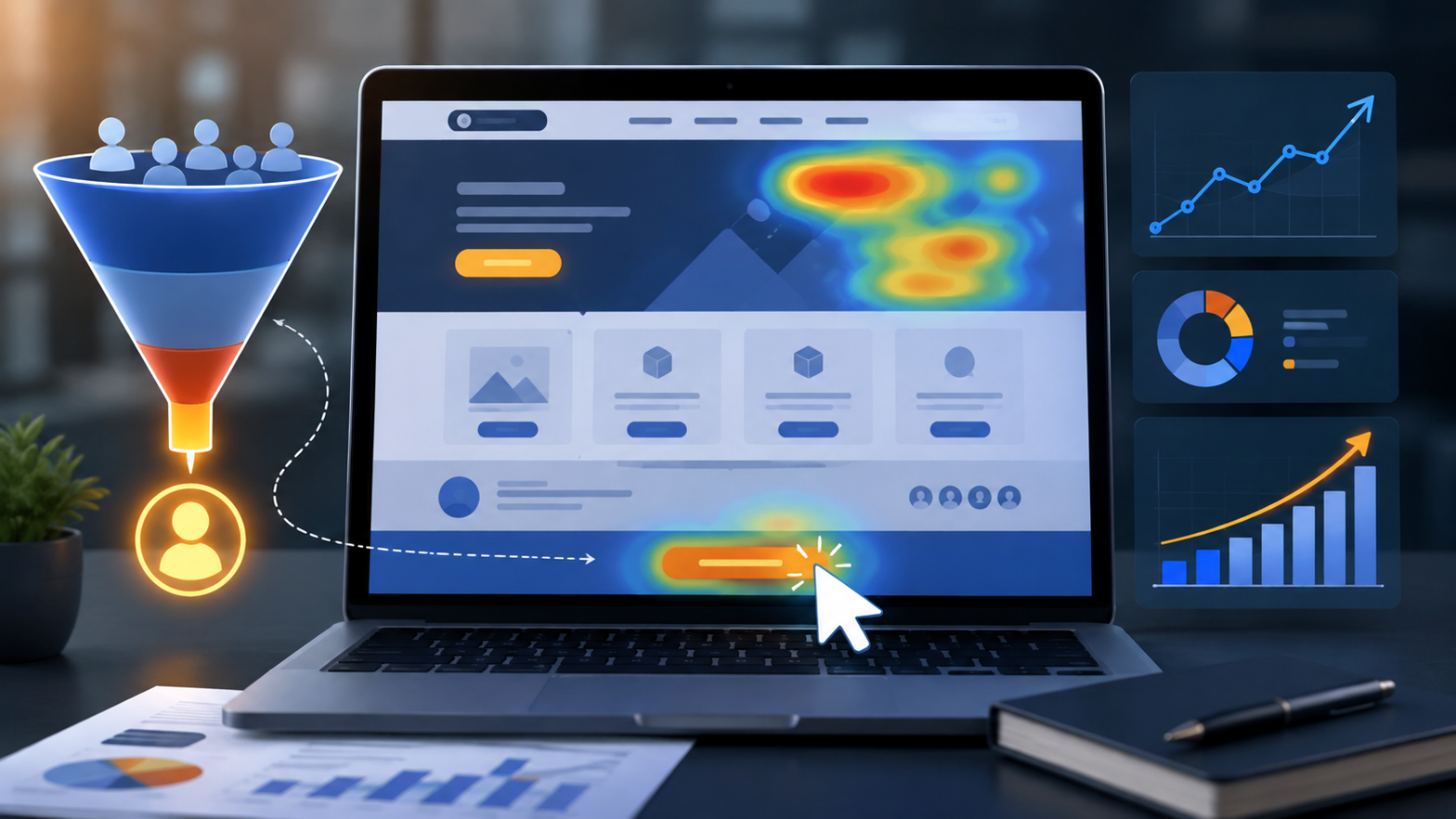
Professional CRO audits also use tools like heatmaps, session recordings, funnel visualization software, and user behavior analytics. These tools show exactly where visitors click, how far they scroll, and at what point they abandon the page. The result is a precise, data-backed roadmap for improvement.
Common Conversion Killers Destroying Your ROI
Want us to build this for you?
Book a Free Discovery CallMost websites lose conversions for a predictable set of reasons. Understanding these conversion killers is the first step toward fixing them. If you want to dig deeper into specific issues your site may have, read more about why your website isn't generating leads and what you can do about it today.
Slow page load times are one of the biggest culprits. Google's own research shows that when a page takes more than three seconds to load, over 50% of mobile visitors leave before seeing a single word. Every additional second of load time costs you conversions. This is not a minor inconvenience; it is a direct drain on revenue.
Confusing navigation is another common problem. If visitors cannot quickly find what they are looking for, they leave. Poor information architecture forces users to think too hard about where to go next, and most simply will not bother. Clear, logical navigation that guides people toward the right page at the right time is a fundamental conversion requirement.
Weak or missing calls-to-action leave visitors with no clear next step. A page that ends without a prompt to call, book, or buy is a missed opportunity. CTAs need to be visible, specific, and relevant to where the visitor is in their decision-making process.
Mobile responsiveness issues are particularly damaging for Canadian businesses right now. Over 60% of website traffic in Canada comes from mobile devices. A site that is hard to navigate, read, or interact with on a phone is losing the majority of its potential leads before they even consider reaching out.
Forms that are too long or poorly designed also kill conversions. Every additional field you ask someone to fill out reduces the likelihood they will complete it. Trust signals, including customer reviews, industry certifications, guarantees, and recognizable partner logos, also play a significant role. Without them, visitors have no reason to believe your business delivers on its promises.
The Hidden Cost of Poor UX Design
Friction is the invisible force that pushes potential customers away from your website. It is not always obvious. Sometimes it is a button placed in the wrong spot, a headline that does not speak to the right pain point, or a checkout process with one too many steps. These small issues compound quickly.
For a service business in Ontario averaging a $2,000 sale, losing just five leads per month to poor UX translates to $10,000 in missed revenue every month, or $120,000 per year. In competitive markets like Barrie, Orillia, or the Greater Toronto Area, that gap is often the difference between a business that grows and one that stagnates. Real-world CRO work consistently shows that fixing a single friction point, such as simplifying a contact form or clarifying a headline, can produce double-digit conversion rate increases within weeks.
What Makes a High-Converting Website?
Want us to build this for you?
Book a Free Discovery CallFrictionless User Experience
A high-converting website makes it easy for visitors to do what you want them to do. The navigation is intuitive, guiding people naturally toward conversion without requiring effort or thought on their part. Visitors should be able to arrive on any page and immediately understand who you are, what you offer, and what they should do next.
The value proposition needs to be clear above the fold, meaning visible without scrolling. If a visitor cannot tell within five seconds why your business is the right choice for them, you have already lost a significant portion of them. Trust elements, such as client testimonials, logos of businesses you have worked with, and review scores, should be placed strategically near conversion points to reinforce confidence at the moment of decision.
Speed and Technical Performance
Website speed is not just a technical detail. It is a conversion factor. A sub-1-second load time should be the baseline for any business serious about converting visitors. Research from Google and Deloitte consistently shows that a 0.1-second improvement in load time can increase conversion rates by 8% or more on retail and lead generation sites.
Mobile-first responsive design is no longer optional. With the majority of Canadian users browsing on smartphones, your site must deliver a flawless experience on smaller screens. AAA accessibility compliance under WCAG guidelines also broadens your audience and ensures no potential customer is excluded based on disability or device limitations. Our Website-as-a-Service model is built around these performance standards as a guaranteed baseline, not an afterthought.
Compelling Copywriting and Messaging
Even a perfectly designed website will fail to convert if the words on the page do not resonate. Conversion-focused copy speaks directly to the customer's pain point, shows empathy, and clearly explains the benefit of taking action. It focuses on what the customer gains rather than what features your service includes.
Social proof woven throughout the page content, including short quotes from real clients, specific results, and named case studies, dramatically increases trust and credibility. Strategic placement of testimonials near CTAs has been shown in repeated A/B tests to improve conversion rates by 15 to 30%. Our conversion-focused copywriting service is built entirely around this principle, using language that moves people toward decisions rather than just describing what you do.
CRO vs SEO: Which Should You Prioritize?
Want us to build this for you?
Book a Free Discovery CallThis is one of the most common questions business owners ask, and the honest answer is that you need both, but CRO often delivers faster and more measurable returns on investment. Our local SEO services are designed to work alongside CRO to create a compounding growth effect.
Traffic without conversions is pure cost. If you are investing in SEO or paid ads to bring 1,000 visitors per month to your site but converting only 1% of them, you are generating 10 leads. Improve your conversion rate to 5% without changing your traffic at all and you now have 50 leads from the same investment. That is a 400% increase in leads with zero additional ad spend.
The multiplier effect works in reverse too. CRO amplifies every dollar you spend on SEO. Better-converting pages tend to have lower bounce rates and longer session durations, which are positive signals that support higher search rankings. So CRO improvements can actually enhance your SEO performance over time.
For Canadian businesses in competitive local markets, the ideal approach is to build a strong SEO foundation while simultaneously optimizing conversion rates. The real-world math makes the case clearly: 1,000 visitors at a 1% conversion rate gives you 10 leads. But 500 visitors at 5% gives you 25 leads at half the traffic cost. Working smarter beats spending more every time.
The CRO Process: From Audit to Optimization
Want us to build this for you?
Book a Free Discovery CallPhase 1: Conversion Audit and Data Analysis
Every CRO engagement starts with a thorough audit of your existing website. This includes heatmap analysis to see where users click and scroll, session recordings to watch real visitor behavior, and a full review of your analytics data. The goal is to identify exactly where visitors are dropping off in your conversion funnel and why.
Benchmarks are established during this phase so that future improvements can be measured against a clear baseline. Without this foundation, you are optimizing blindly.
Phase 2: Hypothesis Development
Once the data is collected, the optimization team identifies which changes have the highest potential impact. Not all opportunities are equal. A change to the main CTA button on your highest-traffic page is worth testing before changing a footer element that rarely gets seen.
Each hypothesis is structured clearly: if we change X, we expect Y to improve by Z. This discipline ensures that testing is purposeful and that learnings are actionable regardless of the outcome.
Phase 3: A/B Testing and Implementation
With hypotheses in hand, A/B tests are designed and launched. Statistically significant sample sizes are required before drawing conclusions. Running a test for only a few days or with minimal traffic leads to false positives that can actually hurt performance. Patience and proper methodology are critical here.
When a test produces a clear winner, the change is implemented permanently. The process then moves to the next hypothesis in the priority queue, creating a continuous cycle of improvement.
Phase 4: Measurement and Scaling
Vanity metrics like page views and impressions do not pay bills. CRO success is measured in revenue impact: more leads generated, lower cost per acquisition, and higher close rates. Tracking these numbers over time shows the compounding benefit of ongoing optimization and builds the case for continued investment. Explore real conversion improvement outcomes in our client results to see what this looks like in practice.
CRO for Local Canadian Businesses
Want us to build this for you?
Book a Free Discovery CallLocal businesses face unique conversion challenges that generic national strategies do not address. A plumbing company in Barrie, Ontario is not competing with businesses in Vancouver. Its customers are searching locally, making decisions quickly, and placing high value on proximity, trust, and responsiveness. See how Barrie businesses are growing with our local approach.
Location-specific conversion strategies account for these nuances. This means highlighting local reviews prominently, mentioning service areas clearly, and using city-specific landing pages that speak directly to the concerns of customers in that community. A homeowner in Barrie is more likely to convert when they see proof that you have served their neighborhood before.
Mobile conversion optimization is especially important for local businesses because most on-the-go searches, such as "emergency plumber near me" or "best dentist in Barrie," happen on smartphones. If your mobile site is slow, hard to navigate, or lacks a click-to-call button, you are losing those high-intent visitors to competitors who make it easier.
Phone call tracking and conversion attribution allow local businesses to understand exactly which pages and traffic sources are driving calls, not just form fills. This visibility is essential for making smart marketing decisions and proving the ROI of your digital investment.
How Much Does CRO Cost and What's the ROI?
Want us to build this for you?
Book a Free Discovery CallProfessional CRO services in Canada typically range from $1,500 to $8,000 per month depending on the scope of work, the size of the website, and the complexity of the testing program. Smaller local businesses may start with a one-time conversion audit in the $1,000 to $2,500 range before committing to an ongoing program.
The ROI calculation is usually straightforward. If your website currently generates 20 leads per month at an average value of $2,500 each, your site is producing $50,000 in monthly pipeline. Improving your conversion rate from 2.5% to 6.8%, a realistic outcome from professional CRO work, would more than double your lead volume from the same traffic. That increase in pipeline revenue would far exceed the cost of the service, often within the first 90 days.
A real example: a Barrie-based service company with 800 monthly visitors and a 2.5% conversion rate is generating 20 leads per month. After CRO work brings that rate to 6.8%, the same 800 visitors now generate approximately 54 leads. At $2,500 per lead, that is an additional $85,000 in monthly pipeline from no additional advertising spend. Book a discovery call to work through the specific numbers for your business.
CRO Myths That Cost Businesses Money
Want us to build this for you?
Book a Free Discovery CallSeveral widely held beliefs about CRO lead businesses to make poor decisions that cost them real money. Getting these wrong can set back your growth by months.
Myth 1: More traffic always equals more conversions. More traffic only helps if your site is already converting at an acceptable rate. Pouring more visitors into a broken funnel just means more people leaving without converting. Fix the conversion rate first, then scale traffic.
Myth 2: CRO is only for e-commerce websites. This is completely false. Service businesses, law firms, contractors, healthcare providers, and B2B companies all have conversion goals. Whether that goal is a phone call, a form submission, or a booked appointment, CRO applies to any website where visitor action has business value.
Myth 3: One-time optimization is enough. User behavior changes. Technology changes. Your competitors change their approach. A website optimized once in 2024 is not necessarily optimized for today's visitors. CRO is an ongoing discipline, not a one-time project.
Myth 4: Following best practices guarantees results. Best practices are starting points, not certainties. What works for one business may not work for another. Your audience, your offer, and your market are specific to you. Only testing against your actual users produces reliable answers.
The truth behind all of these myths is the same: CRO requires continuous testing, real data, and a willingness to let evidence guide decisions rather than assumptions.
When Should You Invest in Professional CRO?
Want us to build this for you?
Book a Free Discovery CallSeveral clear signs indicate that your website is ready for, and in need of, conversion optimization. If you are spending money on advertising but seeing a cost per lead that keeps climbing, CRO is almost certainly part of the answer. If your bounce rate is above 60%, visitors are leaving before they engage. If you cannot clearly explain where your website leads come from, you lack the visibility needed to improve.
For meaningful A/B testing, a minimum of roughly 500 unique visitors per month per page being tested is a general threshold. Below that, tests take too long to reach statistical significance and results become unreliable. That said, a conversion audit and qualitative analysis can provide valuable direction even for lower-traffic websites.
The DIY versus agency question comes down to time, expertise, and the cost of mistakes. Many business owners can implement small improvements with tools like Google Optimize or Microsoft Clarity. But interpreting data correctly, building a structured testing program, and scaling results over time requires experience that most business owners simply do not have and cannot realistically develop while running a company. For Canadian businesses in competitive markets where every lead matters, professional CRO support typically pays for itself quickly and clearly.
Frequently Asked Questions About CRO
Want us to build this for you?
Book a Free Discovery CallWhat is a good conversion rate for a Canadian business website?
A good conversion rate varies by industry and traffic source, but 2% to 5% is generally considered a solid benchmark for service-based businesses in Canada. High-performing websites in competitive industries often achieve 8% to 12%. If you are below 2%, conversion optimization should be a priority.
How long does it take to see results from CRO?
Initial improvements from quick wins, such as fixing broken CTAs, improving page speed, or simplifying a form, can show results within two to four weeks. Full A/B testing cycles typically take four to eight weeks per test depending on traffic volume. Most businesses see measurable ROI within the first 90 days of a structured CRO program.
Can CRO work alongside my current SEO strategy?
Absolutely, and it should. CRO and SEO work best together. SEO brings qualified visitors to your site. CRO turns more of those visitors into customers. Improving your site's conversion rate also tends to improve engagement metrics like bounce rate and time on page, which support stronger search rankings over time.
What's the difference between CRO and web design?
Web design focuses on how a website looks and how it is built. CRO focuses on how well the website performs at converting visitors. A beautifully designed site can still convert poorly if the copy, structure, and user flow are not optimized. CRO often involves design changes, but every change is driven by data and tested for measurable impact.
Do I need a lot of traffic before starting CRO?
Not necessarily. A conversion audit and qualitative analysis using heatmaps and session recordings can provide valuable direction even with modest traffic. For formal A/B testing, more traffic speeds up the process, but low-traffic sites can still benefit from structured CRO work, particularly around removing obvious friction points and improving trust signals.
How do you measure CRO success?
The primary measure is conversion rate improvement, but revenue impact is what truly matters. Successful CRO work should produce more leads, lower cost per acquisition, and higher return from the same or less traffic. Tracking these numbers over time, alongside engagement metrics like bounce rate and session duration, gives a complete picture of performance.
What industries benefit most from conversion rate optimization?
Every industry with a website benefits from CRO, but it produces especially strong results in home services, healthcare, legal, financial services, real estate, SaaS, and e-commerce. Any business where a single converted lead has significant value will see a strong return from professional conversion optimization.
Conversion rate optimization is not a luxury for large businesses with big budgets. It is a practical, measurable discipline that helps any website, from a local contractor in Barrie to a national e-commerce brand, get more value from the traffic it already has. If your website is not working hard enough to turn visitors into customers, the problem is not your traffic. It is your conversion rate. Addressing that is where real growth begins. Book a discovery call with Certtech Web Solutions and let's turn more of your traffic into leads.